
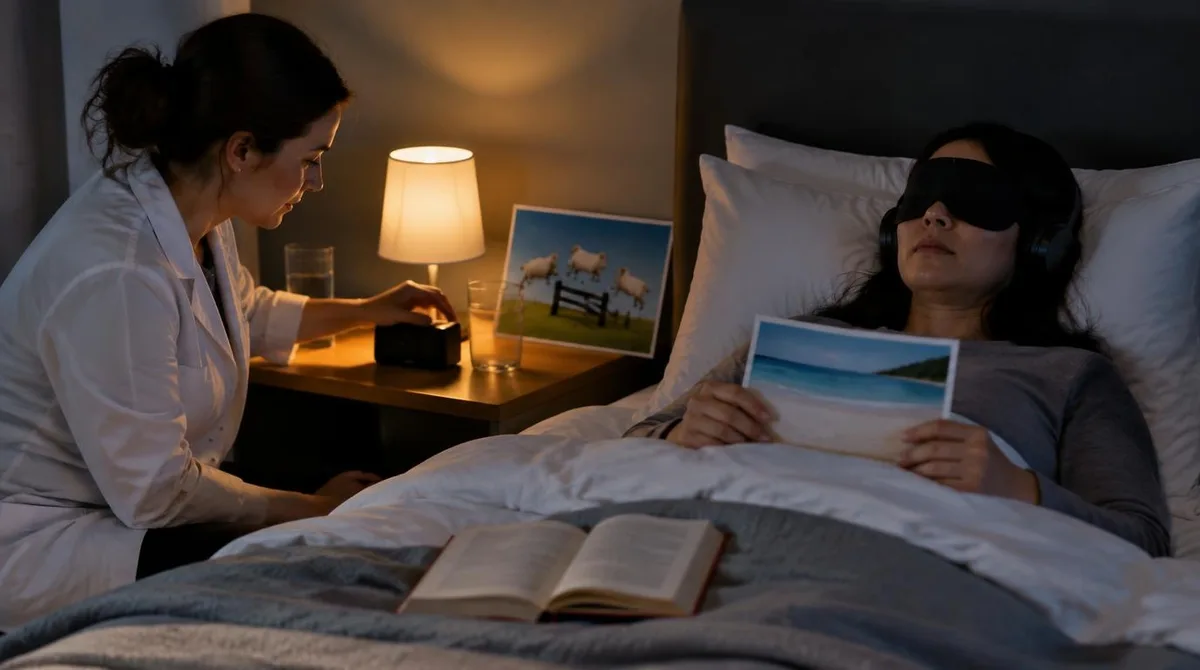
The stress relief sheep method is the old trick of counting imaginary sheep hopping over a fence until sleep arrives. As a sleep aid, it mostly fails. A famous Oxford University test found that calm pictures beat plain counting. People who pictured a beach or a waterfall drifted off faster than people told to distract themselves in a dull, general way. The idea is charming. The science is thin. Better versions of the ritual do exist, and the method survives because it is free, simple and easy to teach.
Sleep researchers describe a healthy wait of about fifteen to twenty minutes between lights out and sleep. When that window stretches night after night, gentle distraction can help. Counting sheep is one such distraction. It is often too dull to hold a worried mind in place. Knowing why it fails points the way to better fixes.
Where the stress relief sheep idea came from
The history runs deeper than most people guess. An early version appears in Don Quixote, a Spanish novel from 1605. There, a story within the tale counts goats crossing a river, not sheep. Scholars trace that story to a twelfth-century book called Disciplina Clericalis. An English novel from 1834 describes sheep crossing a fence and lulling a landowner to sleep. The phrase spread through English print by the 1860s. Cartoons carried the image around the world, and the sheep became the universal sign of trying to sleep. Readers following this should also see Stress Relief Gifts That People Actually Use and Keep.
Why a busy brain blocks sleep
Racing thoughts keep the body's alarm system switched on. The mind replays the day and rehearses tomorrow. A useful distraction hands the brain one soft job instead of five hard ones. That job must be calm enough to settle the nerves. It must also be vivid enough to hold attention. Plain counting fails the second test. Numbers carry no pictures and almost no feeling.
What the Oxford comparison found
In the Oxford test, people with insomnia tried different mental tasks at bedtime. The group that imagined a relaxing scene in clear detail fell asleep fastest. The group told to distract themselves in a general way did worse. The researchers saw a reason. Lively images take more mental effort, so less room stays open for worry. Counting runs on autopilot. The mind drifts back to its troubles, and the sheep get lost along the way.
A smarter version of the stress relief sheep method
The fix keeps the counting and adds pictures. One option is counting slow breaths instead of sheep. That pairs mild distraction with a calming rhythm. The Sleep Foundation lists guided imagery, muscle relaxation and 4-7-8 breathing among its faster-sleep tools. In 4-7-8 breathing, a person inhales for four counts, holds for seven and exhales for eight. Counting sheep at that slow pace, with each animal pictured clearly, turns an old habit into a breathing drill with a friendly face.
Sleep habits that outperform any sheep
Habits carry more weight than mental tricks. Harvard Health urges a steady wake time, even on weekends. The bedroom stays cool, dark and quiet. Screens go away in the two hours before bed, and the bed itself stays reserved for sleep. Caffeine and alcohol get limited, since both break up the second half of the night. When a busy mind still wins most evenings, Harvard points to behavioral care for insomnia as a proven, drug-free path.
Conclusion: keep the ritual, upgrade the plan
The stress relief sheep method is a harmless ritual with a long history and a weak record. Counting alone is usually too flat to hold a stressed mind. Calm, vivid imagery performs better in tests. Pairing a slow count with picture-rich scenes or paced breathing keeps the charm and adds substance. When sleepless nights stack up despite good habits, a clinician visit is the next step. It starts with one honest question about how long the trouble has lasted. We covered a connected angle in Ritual Stress Relief: How Repeated Small Acts Steady the Mind.